
Choosing Right Course to Study Abroad After Graduation!

Choosing the right course to study abroad is one of the most important decisions in your academic journey. With thousands of international programs and universities available, students often have questions such as: Which course should I choose after graduation? What are the best master’s courses after BTech? Can I switch fields for my postgraduate studies? How do I select a course that matches my career goals?
The answer goes beyond choosing a popular course or a highly ranked university. The right study abroad course should align with your academic background, interests, skills, career aspirations, financial situation and long-term plans.
Whether you have completed Civil Engineering, Mechanical Engineering, Computer Science, Commerce, Business Administration, Science or Arts, there are several postgraduate pathways you can explore, depending on university admission requirements.
At Ayodhya Foreign Education, we help students understand their options and plan their study abroad journey through personalised counselling, course selection, university shortlisting and application guidance.
How to Choose the Right Course to Study Abroad

Before selecting a course or university, take time to understand your academic profile and future goals.
Ask yourself these questions:
- Which subjects do I enjoy studying?
- What skills have I developed during my previous degree?
- Which industries interest me?
- Do I want to specialise in my current field or explore a related discipline?
- What type of career would I like to pursue?
- What is my budget for international education?
- Which countries offer suitable programs for my academic profile?
Your answers can help you identify courses that match your interests and qualifications.
Instead of choosing a course simply because it is trending, focus on finding a program that offers relevant subjects, meaningful learning opportunities and a suitable pathway towards your goals.
Best Master’s Courses Abroad Based on Your Academic Background
One of the most common questions students ask is, “What can I study abroad after my bachelor’s degree?”
Your undergraduate qualification can open doors to several specialisations. However, admission depends on the university’s academic requirements, prerequisite subjects and other eligibility criteria.
1. Courses After Civil Engineering
Civil Engineering graduates can explore postgraduate programs related to construction, infrastructure, structural design and sustainable development.

Possible master’s courses include:
- MSc Structural Engineering
- MSc Construction Management
- MSc Transportation Engineering
- MSc Environmental Engineering
- MSc Infrastructure Engineering
- MSc Urban Planning
- MSc Geotechnical Engineering
These programs may suit students interested in infrastructure development, construction projects, structural analysis, transportation systems or sustainable urban development.
When comparing universities, review the technical modules, design software, research facilities, industry projects and specialisation options available.
2. Courses After Mechanical Engineering
Mechanical Engineering graduates can explore specialised programs in manufacturing, automation, robotics, energy and automotive technology.
Possible master’s courses include:

- MSc Mechanical Engineering
- MSc Robotics and Automation
- MSc Mechatronics
- MSc Automotive Engineering
- MSc Manufacturing Engineering
- MSc Industrial Engineering
- MSc Renewable Energy Engineering
Students interested in advanced manufacturing may prefer industrial or manufacturing engineering, while those interested in intelligent machines may explore robotics and mechatronics.
Choose a specialisation based on your technical interests, previous coursework and the skills you want to develop.
3. Courses After Electrical and Electronics Engineering
Students with an Electrical or Electronics Engineering background can consider postgraduate programs in electrical systems, electronics, communication and automation.

Possible master’s courses include:
- MSc Electrical Engineering
- MSc Electronics Engineering
- MSc Embedded Systems
- MSc Power Systems Engineering
- MSc Telecommunications Engineering
- MSc Control Systems Engineering
- MSc Renewable Energy Engineering
Compare course modules carefully to understand whether a program focuses on electronics design, power generation, communication systems, embedded technology or industrial automation.
4. Courses After Computer Science or Information Technology
Computer Science and IT graduates have several options across computing, software development, data and information security.

Possible master’s courses include:
- MSc Computer Science
- MSc Artificial Intelligence
- MSc Data Science
- MSc Cybersecurity
- MSc Software Engineering
- MSc Cloud Computing
- MSc Machine Learning
- MSc Business Analytics
Students who enjoy programming and advanced computing may explore Artificial Intelligence or Machine Learning. Those interested in extracting insights from data may consider Data Science, while students focused on protecting digital systems may explore Cybersecurity.
Review the programming languages, technical prerequisites, project work and research components before selecting a course.
5. Courses After Chemical Engineering
Chemical Engineering graduates can consider postgraduate programs related to industrial processes, materials, energy and environmental sustainability.

Possible master’s courses include:
- MSc Chemical Engineering
- MSc Process Engineering
- MSc Environmental Engineering
- MSc Materials Science and Engineering
- MSc Energy Engineering
- MSc Sustainable Engineering
The best option depends on whether you are interested in process optimization, material development, environmental systems or sustainable industrial practices.
6. Courses After BCom or Commerce
Commerce graduates can explore postgraduate programs in finance, accounting, economics, analytics and international business.

Possible master’s courses include:
- MSc Finance
- MSc Accounting and Finance
- MSc Business Analytics
- MSc International Business
- MSc Economics
- MSc Supply Chain Management
- MSc Banking and Financial Management
Students interested in financial markets may consider Finance, while those who enjoy working with business data may explore Business Analytics.
Check whether the course requires prior mathematics, statistics, accounting or other subject-specific knowledge.
7. Courses After BBA or Business Administration
BBA graduates can consider postgraduate courses that develop their knowledge of management, strategy, marketing and business operations.

Possible master’s courses include:
- Master of Business Administration (MBA)
- MSc Management
- MSc Marketing
- MSc Human Resource Management
- MSc International Business
- MSc Business Analytics
- MSc Operations and Supply Chain Management
- MSc Entrepreneurship
An MBA may be suitable for students seeking broad management education, subject to the program’s entry requirements and any work experience expectations. Specialised master’s programs can be useful for students who want to develop expertise in a particular business function.
Compare course duration, practical projects, industry exposure and admission requirements before making your decision.
8. Courses After Biotechnology and Life Sciences
Students with a background in Biotechnology, Biology or related life sciences can explore postgraduate programs in research, biomedical science and applied biological disciplines.

Possible master’s courses include:
- MSc Biotechnology
- MSc Bioinformatics
- MSc Biomedical Science
- MSc Molecular Biology
- MSc Pharmaceutical Science
- MSc Bioprocessing
- MSc Public Health
The suitability of each program depends on your previous subjects and academic qualifications. Certain biomedical, clinical and healthcare-related programs may have additional prerequisites or professional requirements.
9. Courses After Science and Mathematics
Graduates in Mathematics, Statistics, Physics and related scientific disciplines can consider postgraduate programs that build on quantitative, analytical or research skills.

Possible master’s courses include:
- MSc Data Science
- MSc Statistics
- MSc Applied Mathematics
- MSc Scientific Computing
- MSc Physics
- MSc Business Analytics
- MSc Artificial Intelligence
Some programs may require programming experience, advanced mathematics or specific undergraduate modules. Check these requirements before applying.
10. Courses After Arts and Humanities
Arts and Humanities graduates can explore postgraduate courses in communication, social sciences, education and related interdisciplinary fields.
Possible master’s courses include:

- MA International Relations
- MA Communication Studies
- MA Media Studies
- MA Sociology
- MA Education
- MA Psychology, subject to eligibility
- MA Social Sciences
Students should carefully review entry requirements because certain disciplines, including Psychology, may require a relevant undergraduate background or specific prerequisite subjects.
11. Courses After Architecture
Architecture graduates can consider postgraduate programs related to urban development, sustainable design and the built environment.
Possible master’s courses include:

- Master of Urban Planning
- MSc Construction Management
- Master of Urban Design
- MSc Sustainable Design
- Master of Landscape Architecture
- MSc Building Information Modelling (BIM), where available
Review the course portfolio requirements, design modules, software training and professional accreditation details where applicable.
These course options are starting points for research rather than guaranteed admission pathways. Always confirm the exact requirements on the official university website.
Should You Choose a Trending Course or a Course That Matches Your Interests?
Students researching the best courses to study abroad often focus on subjects that receive significant attention, such as Artificial Intelligence, Data Science, Cybersecurity and Business Analytics.
Although industry trends can be useful when researching career options, they should not be the only factor influencing your decision.
Consider four important factors:
Academic background: Does your previous degree prepare you for the program?
Personal interest: Are you genuinely interested in learning the subjects covered?
Skill development: Will the course help you develop relevant technical, analytical or professional skills?
Career direction: Does the program align with the type of work or further education you are considering?
A popular course may not be the right fit for every student. The goal is to select a program that balances your interests, academic strengths and future plans.
How to Compare Study Abroad Courses Before Applying
Two universities may offer courses with similar names but different curricula, specialisations and practical components.
Before applying, review the following details:
- Course curriculum: Check the core modules and subjects you will study.
- Specialisations: Identify electives and areas in which you can develop expertise.
- Practical learning: Look for laboratory work, industry projects, internships or case studies.
- Research opportunities: Check whether the program includes research projects, a dissertation or a thesis.
- Course duration: Understand the total length of the program and its study structure.
- Teaching approach: Review the balance between lectures, practical sessions and independent study.
- Entry requirements: Verify academic qualifications, prerequisite subjects and language proficiency requirements.
The course title provides an overview, but the curriculum helps you understand what you will actually learn.
Check Your Eligibility for Master’s Courses Abroad
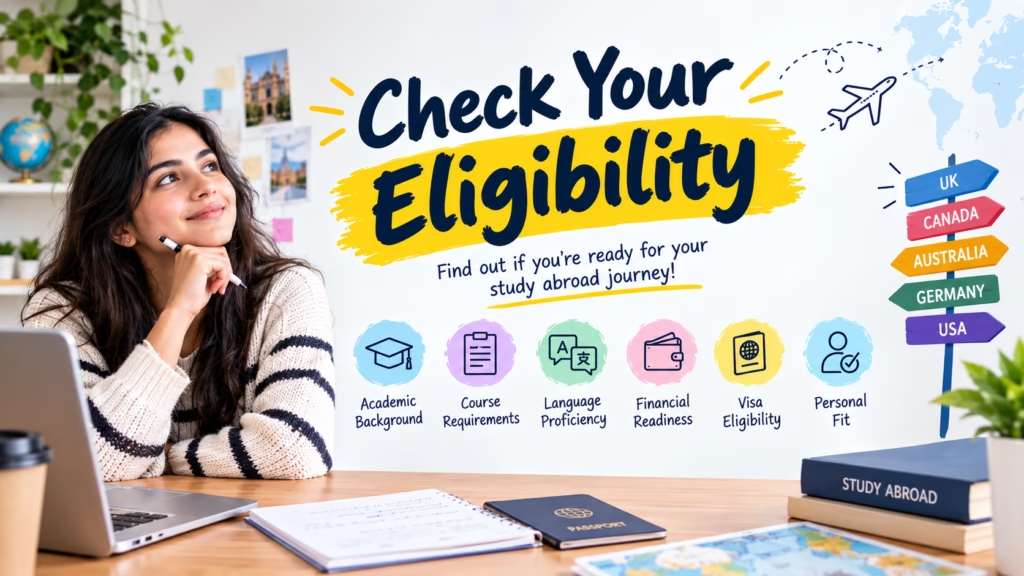
Finding a suitable course is only the first step. You must also meet the admission requirements of the university and program.
Universities may assess:
- Your undergraduate qualification and academic performance
- Relevant subjects studied during your previous degree
- English-language proficiency test scores, where required
- Standardised test scores, where applicable
- Relevant professional experience, if required
- Portfolio submissions for certain creative programs
- Letters of recommendation, statements of purpose and other application documents
Requirements vary by institution, country and course. A student who qualifies for one master’s program may not automatically qualify for another.
Start researching eligibility early so you have enough time to prepare the necessary documents and meet application deadlines.
How to Choose the Best Country for Your Course
Selecting the right destination is another important part of planning your international education.
Students may compare destinations such as the USA, UK, Canada, Australia, Germany, Ireland and other European countries based on their preferred courses and individual circumstances.
When comparing countries, consider:
- Course and university options: Identify countries with universities offering your preferred specialisation and relevant industry-focused programs.
- Course duration and academic structure: Compare program length, practical learning, research opportunities and internship components.
- Tuition fees and living expenses: Evaluate the overall cost of education, accommodation, transportation and other daily expenses.
- Scholarships and available funding: Research university scholarships, government funding and other eligible financial support.
- Job market and industry demand: Explore the industries operating in your chosen country and research the types of roles relevant to your qualification.
- Internships and work experience: Check whether your course offers internships, industry placements, practical projects or opportunities to gain relevant experience.
- Post-study employment opportunities: Research the eligibility requirements for graduate employment pathways and the rules governing work after graduation.
- Language and professional requirements: Consider the language skills, professional certifications or local qualifications that employers may expect.
- Student support and career services: Check whether universities offer career counselling, CV workshops, employer networking, job fairs and placement support.
- Student visa and work regulations: Understand the rules for working while studying and the current requirements for staying and working after graduation.
Do not choose a country solely because it is popular among other students. The right destination depends on your academic profile, financial plan, preferred learning environment and long-term goals.
Always verify current visa rules and post-study work conditions through official government sources.
Understand the Cost of Studying Abroad
Your study abroad budget should include more than tuition fees.
Plan for accommodation, food, transport, health insurance, travel, visa-related expenses, study materials and personal costs.
You should also research scholarships offered by universities, governments and other legitimate funding organisations. Eligibility, application deadlines and award amounts can vary considerably.
Compare the total estimated cost of each option rather than looking only at tuition fees. A realistic financial plan can help you shortlist universities that fit your circumstances.
How Does Your Course Choice Affect Your Career Opportunities?
A postgraduate qualification can help you build specialised knowledge and develop skills relevant to your chosen field. However, completing a particular degree does not guarantee a job, salary or employment visa.
Before selecting a program, research the types of roles associated with the field, the skills employers request, and the professional requirements that may apply.
For example:
- Students interested in data-related roles can review programs covering statistics, programming, machine learning and data visualisation.
- Students interested in international business can explore subjects such as strategy, finance, marketing and global operations.
- Students interested in engineering design can investigate programs that include relevant technical modules, software and project work.
Consider both your immediate interests and your longer-term development. A course should help you make progress towards your goals while leaving room for learning and growth.
Common Mistakes to Avoid When Choosing a Study Abroad Course
Students can make more informed decisions by avoiding these common mistakes:
Choosing a course only because it is trending: Popularity does not automatically mean suitability.
Prioritising university rankings alone: A highly ranked institution may not offer the curriculum or specialisation you need.
Ignoring eligibility requirements: Always verify prerequisites before investing time and money in an application.
Overlooking the total cost: Tuition fees are only one part of your overall study budget.
Assuming a job is guaranteed: Employment outcomes depend on many factors, including skills, experience and labour market conditions.
Following friends or family without researching alternatives: Gather information and evaluate options according to your own academic profile and goals.
Ignoring the curriculum: Review what you will learn instead of relying only on the course name.
A structured comparison of programs can help you avoid unnecessary applications and focus on suitable opportunities.
Step-by-Step Roadmap to Choose the Right Course Abroad
Follow this process to organise your course-selection journey:
- Assess your academic background and interests.
- Identify relevant postgraduate course options.
- Define your preferred career direction.
- Compare curricula and specialisations.
- Check university eligibility requirements.
- Research suitable countries and universities.
- Estimate tuition fees and living costs.
- Explore scholarships and funding options.
- Prepare application documents and track deadlines.
- Shortlist programs that align with your goals and budget.
Starting early gives you more time to research universities, prepare documents and make decisions carefully.
Why Choose Ayodhya Foreign Education for Study Abroad Guidance?
Choosing a course, country and university can be challenging when you are comparing multiple options.
Ayodhya Foreign Education supports students through personalised guidance at different stages of their study abroad journey.
Our services include:
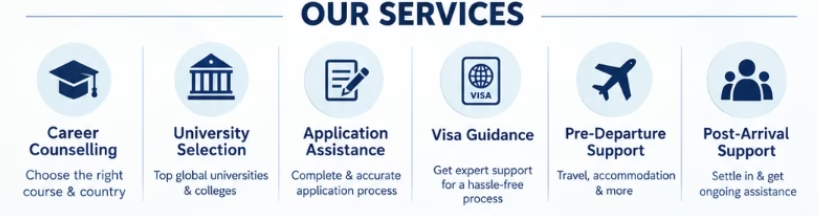
- Personalised career counselling
- Test preparation guidance
- Course and country selection
- University shortlisting
- Application and admission assistance
- Scholarship guidance
- Education loan assistance
- Student visa processing support
- Forex, travel ticketing and related services
Our aim is to help students understand their options and plan their next steps with greater clarity. Course recommendations and admissions depend on each student’s profile and the relevant university requirements.
Whether you are exploring master’s courses after BTech, postgraduate programs after BCom, or international study options after a science or arts degree, we can help you understand the pathways worth researching.
Frequently Asked Questions About Choosing a Course Abroad
Which course is best to study abroad after graduation?
There is no single best course for every student. The right choice depends on your undergraduate degree, interests, academic eligibility, career goals and budget. Engineering graduates may explore technical specialisations, while commerce graduates may consider finance, accounting or business analytics, subject to university requirements.
Can I change my field when applying for a master’s abroad?
Some universities allow students to move into related or interdisciplinary fields, while others require a closely related undergraduate qualification. Check the specific entry requirements of each program before applying.
What are the best master’s courses after BTech?
Depending on your engineering branch, you may explore Mechanical Engineering, Structural Engineering, Robotics, Data Science, Artificial Intelligence, Renewable Energy or other specialised programs. Your previous subjects and the university’s requirements determine which options are suitable.
How do I select a country for higher education?
Compare countries based on available programs, university requirements, total cost, scholarships, teaching approach, student support and applicable immigration regulations. The best destination depends on your personal circumstances and academic goals.
Are scholarships available for international students?
Many universities and organisations offer scholarships, but availability, eligibility and award amounts differ. Research official scholarship pages and check application deadlines before applying.
When should I start planning to study abroad?
Starting several months before your intended intake is a useful approach because you may need time for course research, university applications, language tests, financial planning and visa documentation. The ideal timeline depends on the destination, program and application deadlines.
Final Thoughts: Choose the Right Course for Your Future
Choosing the right course to study abroad begins with understanding yourself, your academic background and the future you want to build.
A Civil Engineering graduate may explore Structural Engineering or Construction Management. A Mechanical Engineering graduate may consider Robotics or Mechatronics. A Computer Science graduate may investigate Artificial Intelligence or Data Science, while a Commerce graduate may explore Finance or Business Analytics.
The important step is to evaluate each option carefully rather than selecting a program based only on trends or recommendations.
Your decision should bring together your academic qualifications, interests, skills, career aspirations, financial plan and long-term goals.
Ready to explore your study abroad options?
Connect with Ayodhya Foreign Education for personalised guidance on course selection, country selection, university admissions, scholarships and other study abroad services.
Visit www.ayodhyaedu.com or contact our team to discuss your academic profile and plan your next steps.
Choose your course with purpose. Choose your destination with clarity. Build your future with confidence.